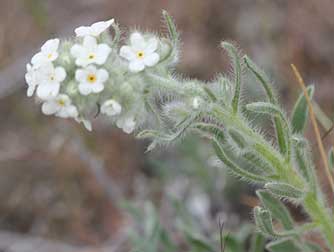
Shrub Steppe - Eastern Washington State

White forget-me not

Eastern Washington


» Eastern Washington desert wildflowers
» Eastern Washington plants
» Eastern Washington animals and plants

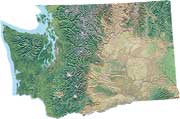
Eastern Washington map of wildlife and recreation areas

Related information
Cryptantha spiculifera photos and WA distribution map - UW Herbarium
Cryptantha spiculifera - WA Heritage Program
Cryptantha - Wikipedia

Join a network for good:
Washington Native Plant Society

Related Books
Wildflowers of the Pacific Northwest
Sagebrush Country: A Wildflower Sanctuary
Wildflowers of the Inland Northwest
Plants of Southern Interior British Columbia and the Inland Northwest
Northwest Penstemons: 80 Species in Washington, Oregon, Idaho and Montana
Last Child in the Woods: Saving Our Children from Nature-Deficit Disorder


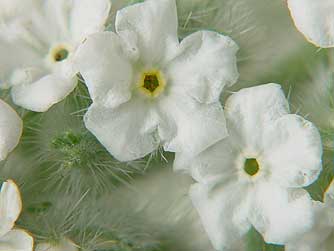
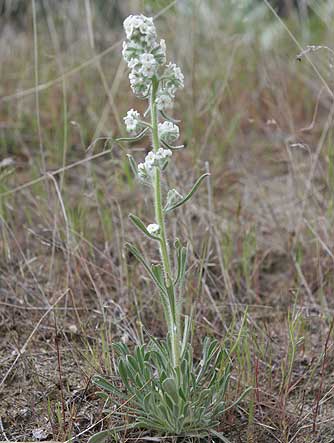
Picture of White forget-me-not or Cryptantha spiculiferaWhite forget-me-not is an Eastern Washington native plant having multiple, somewhat bristly stems densely covered by delicate white flowers with yellow eyes, and hairy gray-green foliage. This perennial wildflower, also called cryptantha, is nicely adapted hot, dry conditions, favors sandy places in the shrub-steppe and pine woods, and blooms in mid-spring.

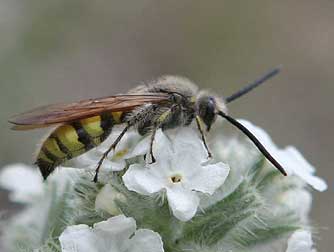
White forget-me-not flowers have deep nectaries that sustain an assortment spring-foraging bees, beneficial wasps including beetle-eating scoliid wasps, and spring-flying butterflies including Becker's white, Boisduval's blue, silvery blue, acmon/lupine blue, arrowhead blue, green hairstreaks and gray hairstreak butterflies. Cryptanthas can be found in the Columbia Basin and across the arid Great Basin from British Columbia to California and east to Texas and Montana.

White forget-me-not blooms just a little before and with silverleaf phacelia and alonside with flowering mustards that like sandy, eroding hillsides. It also grows where late-spring blooming Douglas' dustymaiden and silky lupine grow, and with gray-green, late-summer blooming snow buckwheat.

According to Young and Young's Collecting, Processing and Germinating Seeds of Wildland Plants, nutlets of the related large-flower cat's-eye or Cryptantha intermedia need no special treatment to germinate. Above-ground, these plants dry completely in the heat of summer and their nutlets fall to the hot sand, suspended in air on spiny calyx hairs. Seeds apparently fall out with the rains of autumn and get covered with damp sand to germinate later. These cryptanthas seem more common on east- and west-facing hillsides, microclimates that are exposed to the hot sun in spring but remain in shadow on sunny, frozen winter days.


White forget me not wildflowers
White forget-me-not or cryptantha wildflowers - May
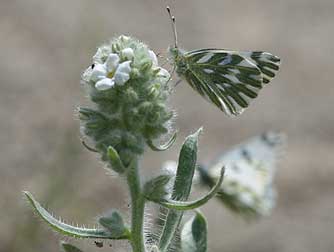
 

Spring white butterfly and Becker's white butterfly nectaring on white forget-me-not or Snake River cryptantha
Cryptantha swarmed by spring white
and Becker's white butterflies
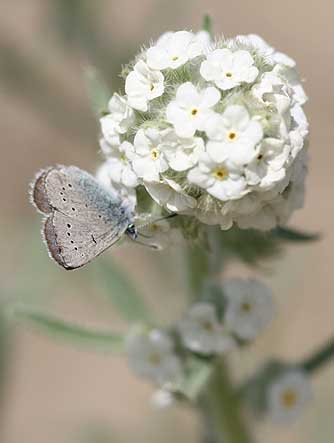
 

Picture of silvery blue butterfly nectaring on Snake River cryptantha
White forget-me not
providing nectar for silvery blue butterfly
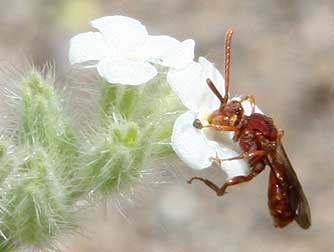
 

Red nomad bee foraging for nectar on white forget-me-not
White forget-me not providing nectar
for a red nomad bee
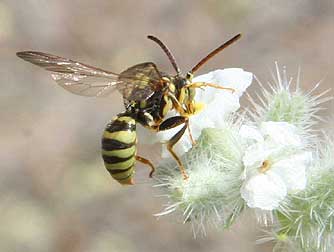
 

Cryptantha with cuckoo bee
Cryptantha with a cuckoo bee


Scarab Hunter Wasp foraging for nectar on white forget-me-not wildflowers
White forget-me not providing nectar
for the beneficial scarab hunter wasp
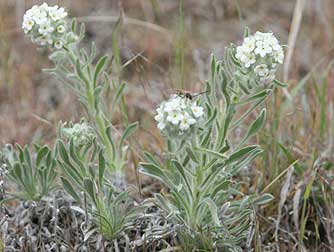
 

Whte forget-me not widflower picture
White forget-me not


Picture of white forget-me not, Snake cat's eye or Snake River cryptantha
White forget-me not, cat's eye or Snake River cryptantha
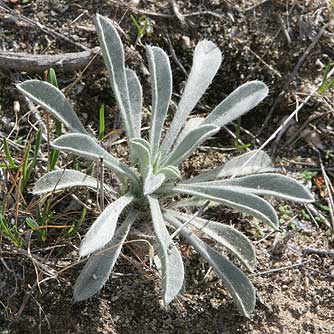
 

Cryptantha rosette in October



www.bentler.us

© Copyright 2004-2010 All rights reserved
A society grows great when old men plant trees whose shade they know they shall never sit in.
» Interactive Washington map
» Washington State map