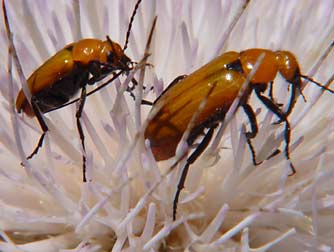
Orange Nemognatha blister beetle
Blister beetles in the genus Nemognatha can be seen in mid to late summer feeding on the nectar and pollen of thistles and other composite flowers. Their bright color serves as a warning for predators to avoid them, like other colorful insects such as the toxic monarch butterfly, milkweed beetle, or stinging velvet ant. Nemognatha blister beetles produce a highly toxic substance known as Cantharidin, which blisters skin, causes digestive and urinary problems when swallowed, and can be lethal in small amounts.
The male beetle produces this toxin and transfers some to the female during mating, enabling her to coat her eggs for protection against egg-eating insects. The female beetle lays eggs on flowers where the larvae hatch, find and attach to foraging bees, then ride to nest burrows where the beetle larvae parasitize developing solitary bee larvae.
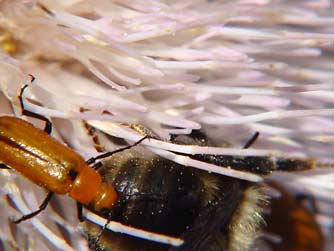
Orange Nemognatha blister beetle
climbing on the back of a long-horned bee
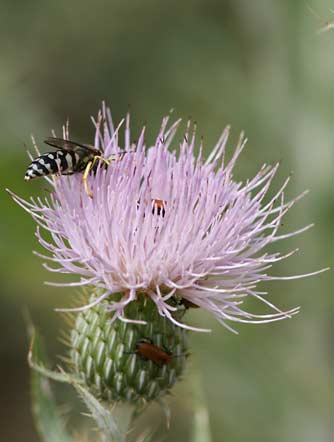
Orange Nemognatha blister beetles
on wavyleaf
thistle flower, with Bembicine Sand Wasp
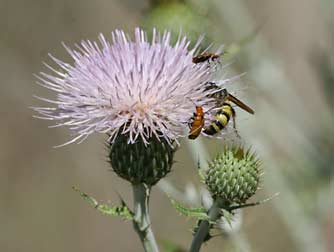
Nemognatha blister beetles
with a scoliid
wasp